

Pozzolan
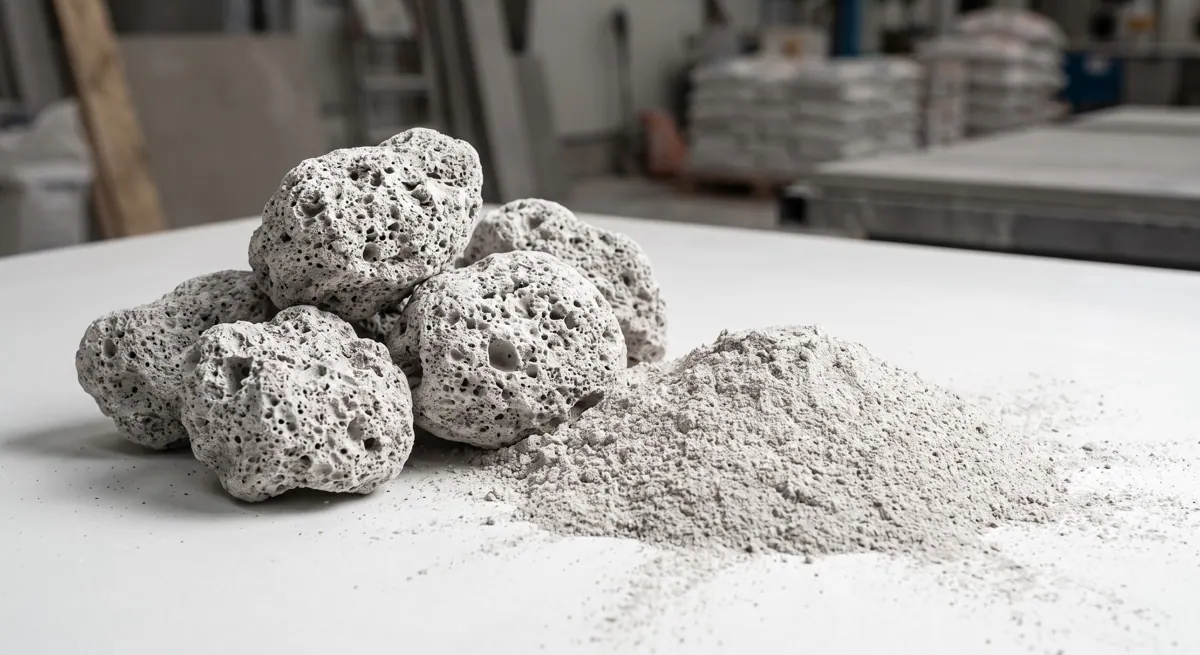
Natural pozzolan, from Oregon airfall pumice.
A pozzolan is a fine mineral that reacts with the lime left over when cement cures, turning a weak point in concrete into more binder. Volcanic pumice is one of the original natural pozzolans, and it's the only thing we mine.
The basics
What is a pozzolan?
A pozzolan is a siliceous, or siliceous and aluminous, material that has little cementing value on its own — but when finely ground and in the presence of moisture, it reacts chemically with calcium hydroxide to form compounds that act like cement. In concrete, that means a pozzolan doesn't just fill space: it becomes part of the binder.
The idea is older than Portland cement itself. Roman engineers mixed volcanic ash with lime to build harbors, aqueducts, and the Pantheon; the word pozzolan comes from Pozzuoli, the town near Vesuvius where they dug it. Modern concrete rediscovered the same chemistry, and materials that supply it are known today as supplementary cementitious materials, or SCMs.
A natural pozzolan is one that comes out of the ground ready to do this work — volcanic ash, tuff, and pumice chief among them.
The chemistry
How the pozzolanic reaction works.
When Portland cement hydrates, it produces the glue that holds concrete together — and a byproduct, calcium hydroxide, that contributes little strength and is a weak link for durability. A pozzolan puts that byproduct to work.
Portland cement + water
Produces C-S-H, the binder that gives concrete its strength — plus leftover calcium hydroxide (lime).
Calcium hydroxide + fine pumice
The reactive silica and alumina in volcanic glass combine with the leftover lime and moisture.
Additional C-S-H binder
A denser, less permeable cement paste, with a vulnerable byproduct converted into more of the glue itself.
Pumice is well suited to this role because it is volcanic glass: quenched so quickly in the eruption that its silica never crystallized, leaving it in the reactive, amorphous state the reaction depends on. How much any given pozzolan contributes depends on its chemistry, fineness, and the mix it goes into — which is why testing matters.
Why it's used
What a natural pozzolan can do for concrete.
Replacing a portion of Portland cement with a suitable natural pozzolan is standard practice with a long track record. Depending on the material, the dosage, and the mix design, engineers use natural pozzolans to pursue:
- Lower embodied carbon — every ton of clinker a mix doesn't use is a ton that didn't have to be fired in a kiln
- Reduced permeability and a denser paste, from converting calcium hydroxide into additional binder
- Improved resistance to sulfate attack and mitigation of alkali-silica reaction (ASR) in susceptible aggregates
- Lower heat of hydration — the historical reason pozzolans went into large dams and mass pours
- Long-term strength gain as the pozzolanic reaction continues over time
These are established, general properties of natural pozzolans as a class. Actual performance always depends on the specific material, its processing and fineness, the replacement level, and the application — no supplier can promise them in the abstract, and we don't.

Applications
Where natural pozzolan goes to work.
- Ready-mix concrete, as a partial replacement for Portland cement
- Blended cements, where pozzolan is interground or blended at the cement plant
- Mass concrete — dams, foundations, and thick pours where heat must be controlled
- Precast and concrete products
- Mortars, grouts, and plasters — the original lime-pozzolan use, still current
- Concrete exposed to sulfates, seawater, or reactive aggregates, subject to mix-specific testing
With coal-fired power plants retiring and fly ash supplies shrinking, producers across North America are actively qualifying natural pozzolans to fill the gap.
Why our pumice
One deposit, built for this job.
Beaver Pumice mines 100% natural airfall pumice from a high-purity deposit near Crater Lake, Oregon — volcanic glass laid down by the eruption of Mount Mazama and never crushed from solid rock. Pozzolan is one of the applications our material has served from the start.
- A high-purity airfall deposit: consistent source material, load after load
- Fine and crushed grades already in the line — 3/8″ Minus, 1/4″ Minus, and crushed pumice — with custom gradations milled to order
- An onsite laboratory to verify gradation before material ships
- A trucking network with high-capacity trailers to get bulk material to your plant
If you're evaluating natural pozzolan sources, start the conversation with a sample and your spec — we'll tell you plainly what our material can do and what your testing needs to confirm.
Sustainability
The carbon case, stated plainly.
Portland cement production is one of the largest industrial sources of CO₂ in the world, because making clinker means calcining limestone at very high temperature. A natural pozzolan is mined, dried, and ground — it skips the kiln entirely.
So the sustainability argument is simple and honest: when a suitable natural pozzolan replaces a portion of the Portland cement in a mix, the emissions associated with producing that share of clinker are avoided. How much that amounts to depends on the replacement level, the processing and transport of the pozzolan, and the project — we'd rather you run those numbers for your case than quote you a universal percentage.
Common questions
Pozzolan, briefly.
Is pumice a pozzolan?
Pumice is a volcanic glass, and finely ground volcanic glass is one of the classic natural pozzolans — it's the family of material the Romans used. Whether any specific pumice performs as a pozzolan in your mix is a matter of its chemistry and fineness, verified by testing.
Can pumice replace Portland cement?
Partially, not entirely. A pozzolan needs the calcium hydroxide that cement hydration produces, so it works alongside Portland cement rather than in place of it. Replacement levels are set by mix design and testing for each application.
What's the difference between a pozzolan and cement?
Portland cement reacts with water directly and hardens on its own. A pozzolan has little cementing ability by itself — it needs moisture and calcium hydroxide to react. In a concrete mix the two are complementary: cement supplies the lime, the pozzolan turns it into additional binder.
What is a supplementary cementitious material (SCM)?
Any material that contributes to a concrete's properties through hydraulic or pozzolanic activity alongside Portland cement. Fly ash, slag cement, silica fume, and natural pozzolans like pumice are the common ones. With fly ash supplies declining as coal plants retire, natural pozzolans are taking a growing share of that role.
What testing is required before using a natural pozzolan?
Typically: chemical and physical characterization under ASTM C311 against the C618 Class N requirements, a strength activity index against a control mix, and then trial batches in your actual mix design. Application-specific tests — like ASTM C1567 for ASR mitigation — follow where relevant.
Does using a pozzolan change how concrete cures?
The pozzolanic reaction is slower than cement hydration, so mixes with meaningful pozzolan content often gain early strength somewhat more slowly and continue gaining strength longer. Heat of hydration is generally reduced — one reason pozzolans have always been used in mass concrete.
How do I request technical information or a sample?
Call +1 541-891-1819 or use the contact form. Tell us the application and the spec you're working to, and we'll take it from there.